Buyers often meet emissions rules only as a sticker on the engine block, but each generation of rules changed the parts list on a Kobelco excavator permanently. A machine built before these rules, a machine with cooled EGR, a machine with a diesel particulate filter and a machine with selective catalytic reduction are four different shopping lists. Guangzhou Shenyue Machinery Technology Co., Ltd. supplies the aftertreatment and engine-side parts across all of those generations, and the map below shows which stage added which hardware.
Tier 2 and Tier 3: the simple era
Machines up to the mid-2000s ran mechanically governed or early electronically governed engines with no exhaust aftertreatment at all. The parts list here is the classic one: injection pump and nozzles, turbocharger, water pump, cylinder head components. These machines still run worldwide, and the demand for their parts is steady — which is why our records still cover injectors, pump-side components and turbochargers for the older SK-6 and SK-7 families alongside the newest engines.
Cooled EGR: the first hardware step
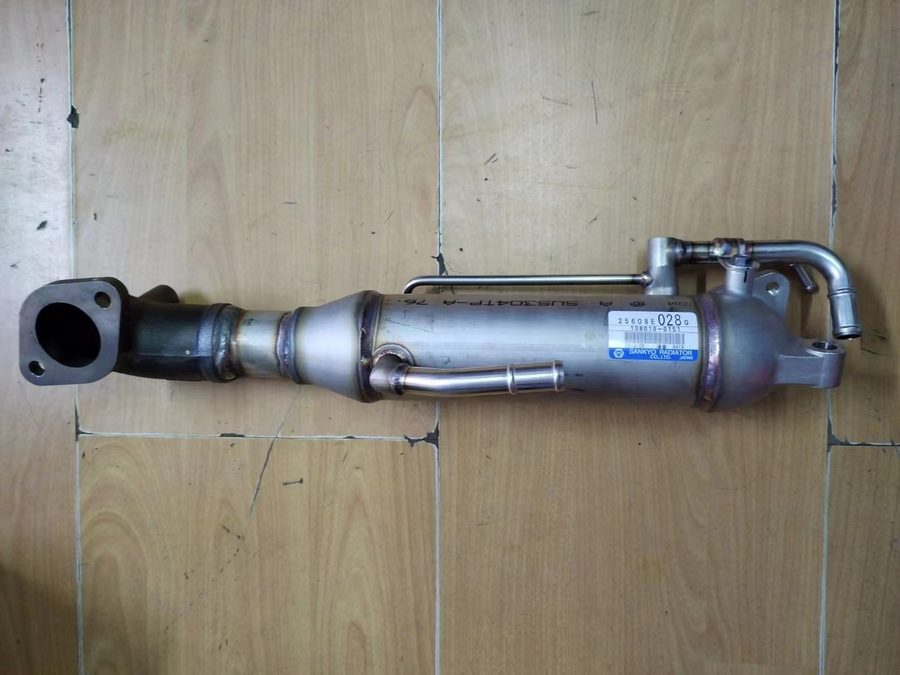
The first big change was exhaust gas recirculation. A cooler takes exhaust gas, cools it and feeds it back into the intake to cut combustion temperature. The cooler is a water-cooled shell that lives in a hot, sooty corner of the engine, and it is the single most failure-prone part this stage added: coolers crack internally and leak coolant into the intake, which shows up as white smoke and a derated engine. Our records quote EGR coolers for the Hino J05-class machines under VH25608E0280 and VHS173091120, plus gasket VH25634E0020 and the EGR solenoid VH25620E0133. On the Mitsubishi-sourced D04EG fitted to short-radius SK135SR and SK140 machines, the cooler is recorded under VA32K3201100 — the failure signs are identical and are walked through in our D04EG EGR cooler guide.
Tier 4 Interim: DPF joins the system
The next stage added a diesel particulate filter and a dosing strategy to regenerate it. Regeneration needs sensors, temperature management and periodic attention, and a clogged or damaged DPF turns into derates and alarm codes. The practical purchasing impact is that exhaust-side sensors and clamps became consumable-adjacent items, and diagnosis moved from the eyes to the fault-code reader. Our DPF and EGR service guide covers the alarm patterns this generation produces.
Tier 4 final and Stage IV: SCR arrives
Full Stage IV added selective catalytic reduction: a diesel exhaust fluid tank, a dosing pump and injector, and an SCR catalyst. DEF is a maintenance item with its own shelf life and its own winter behaviour, and neglecting it stops the machine as surely as a failed pump. Our DEF and SCR care guide covers the daily discipline this stage demands.
The newest generation
The latest SK200-12 generation runs a 4.5-litre engine certified to China Stage IV, and the parts around it follow the same logic — new head gaskets under VW5345651, a new turbocharger pattern under VW5606654, and the sensor suite that feeds the emissions control. Kobelco's own machine range and emissions positioning are described at kobelco.co.jp. What matters for buyers is that the newest generation did not simplify the parts list; it extended it.
Sensors around every stage
Each stage also multiplied the sensor count that feeds the emissions control: temperature probes around the exhaust, pressure and level sensors on the DEF side, position and flow feedback around the EGR path. Sensors rarely fail on a calendar; they fail on heat cycles and connector corrosion, which is why a fault code pointing at a sensor should always include a connector inspection before the sensor is ordered. Where a sensor is shared across engine variants, the serial decides the correct part — the same housing often hides two different ranges. Guangzhou Shenyue Machinery Technology Co., Ltd. quotes the sensor families per serial range rather than per engine family name, because that is how the service parts actually divide.
Ordering across generations
Guangzhou Shenyue Machinery Technology Co., Ltd. keeps aftertreatment-adjacent stock as part of more than 3,000 part types on the shelf, with over 100,000 part numbers available to order, and every component is graded genuine, OEM or aftermarket on the quotation. If your fleet mixes generations, build the parts list per machine rather than per model name, and if your enquiry spans several brands beyond Kobelco, our colleagues at corbayparts.com handle the same emissions families across the wider fleet.
Frequently Asked Questions
Which Kobelco machines have an EGR cooler that can fail with white smoke?
Cooled-EGR machines from the Tier 4 era onward, including J05-class engines and the D04EG in short-radius SK135SR and SK140 machines. Our records quote coolers under VH25608E0280, VHS173091120 and VA32K3201100; an internal crack leaks coolant into the intake and derates the engine.
What parts did Stage IV add compared with Tier 3?
Cooled EGR hardware, a diesel particulate filter on interim machines, and on final machines a DEF tank, dosing pump and injector plus an SCR catalyst. Each added stage also added the sensors and gaskets around it, which is why later generations carry a longer parts list.
How do I confirm which emissions generation my Kobelco carries?
Read the engine nameplate and the machine serial range rather than the model year, because serial ranges decide the aftertreatment fitted. Send the nameplate photo and Guangzhou Shenyue Machinery Technology Co., Ltd. will match coolers, gaskets and sensors from records covering over 100,000 orderable part numbers.
Are aftertreatment parts available as aftermarket?
Yes, selected EGR coolers, gaskets and sensors are offered as OEM or aftermarket alongside genuine units. Every line is graded genuine, OEM or aftermarket on the quotation so the workshop knows exactly which standard it is buying.