Engine oil is the cheapest insurance on an excavator and the most often compromised. On a Kobelco, the engine spends its life at high load with a turbocharger and — on later generations — exhaust aftertreatment hanging on the crankcase ventilation, so the oil category matters more than the brand on the drum. Guangzhou Shenyue Machinery Technology Co., Ltd. supplies engine oils' surrounding hardware, filters and coolers, and this guide sets out how we talk through oil choices with workshop buyers.
The category ladder, briefly
Heavy-duty diesel oils are graded by API category. Older categories were built for engines without aftertreatment; the transition to low-ash categories such as CJ-4, and then CK-4, came with the emissions generations precisely because high-ash oils blind DPFs and poison SCR systems. Newer categories also carry better shear stability and oxidation control for the higher temperatures a turbocharged engine sees. The safe rule: use the category the engine manual specifies, never an older category than specified, and when two machines share a drum, buy for the newest engine in the fleet.
Viscosity follows climate, not habit
Grades in the 15W-40 range are commonly quoted as the default for mixed-climate operation, with lighter grades quoted for consistent cold work; the exact choice belongs to the engine's service manual and the ambient range the machine actually works in. The nameplate authority matters more than forum folklore. What we watch in practice is the opposite failure: buyers downgrading viscosity for price, then seeing oil pressure complaints at hot idle — the symptom pattern is covered in our low oil pressure diagnosis guide.
The filter is half the specification
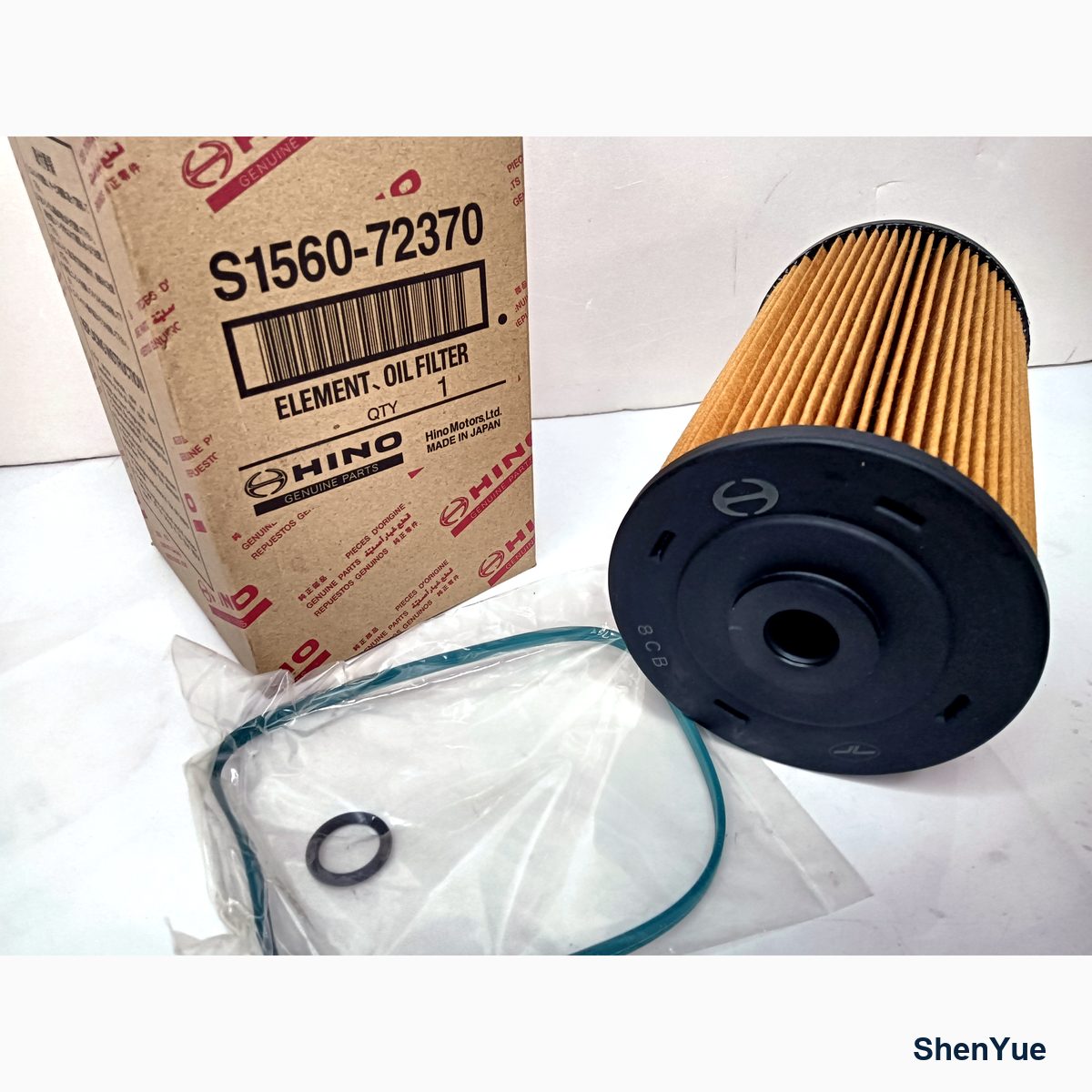
An oil filter is a bypass safety device as much as a cleaner: when the media loads up, the bypass opens and unfiltered oil circulates. A stretched interval with a tired filter is worse than a shorter interval with a good one. Our records quote engine oil filters for the Hino P11C-class engines under VH156072370 and VHS156072380, a filter assembly under VH15601E0070 for the SK460-8, and J05-class filters recorded under VA32G4001100J1J, VA32G4001100J1M and VA3424011101. Match by engine and serial, because filter families changed across generations exactly like aftertreatment parts did.
Oil and the cooling circuit work together
The oil cooler keeps the oil inside its working window, and a fouled cooler makes good oil look bad by pushing temperatures past the category's comfort zone. When temperature drifts upward on a machine whose oil practice is sound, our records quote oil cooler cores such as VHS157121880 for J05-class machines — cleaning first, replacement when the core is beyond it. Fuel quality interacts too, since dilution thins oil from the fuel side; the discipline is covered in our fuel quality guide.
Change intervals and the hour meter
Factory intervals are the ceiling, not the target. Dusty sites, short-cycle duty and high idle hours all push real oil life down, and many workshops shorten the interval in proportion to the duty rather than arguing with the manual. The habit that pays is trend-based: if the sample programme shows stable results at the factory interval, hold it; if wear metals or dilution climb, shorten before the next sample. Keep the change kit complete — filter, gaskets and drain hardware together — because half-finished changes cause the leaks that end in low-pressure complaints. Guangzhou Shenyue Machinery Technology Co., Ltd. quotes these kits as single lines where the records allow, so the interval discipline does not stall on a missing small part.
What we supply around the oil
Guangzhou Shenyue Machinery Technology Co., Ltd. keeps the oil-side hardware — filters, cooler cores, gaskets and drain hardware — as part of more than 3,000 part types on the shelf, with over 100,000 part numbers available to order, every line graded genuine, OEM or aftermarket. Hino's own engine documentation, which underpins the factory oil positions for J05 and P11C engines, is published at hino-global.com. If your purchasing covers several engine brands across the fleet, our colleagues at excavatorpartsglobal.com quote the same oil-side families for the wider machine park.
Frequently Asked Questions
Which API oil category should a Kobelco with a DPF use?
A low-ash category such as CJ-4 or CK-4, as specified in the engine manual. High-ash older categories blind diesel particulate filters and shorten aftertreatment life, so never step down to an older category than the manual specifies.
What oil filters do you record for Hino-powered Kobelco machines?
Our records quote P11C-class engine oil filters under VH156072370 and VHS156072380, a SK460-8 filter assembly under VH15601E0070, and J05-class filters under VA32G4001100J1J, VA32G4001100J1M and VA3424011101, all graded genuine, OEM or aftermarket.
Can I use one oil grade across a mixed fleet?
Only if every engine manual allows it, and in practice the newest aftertreatment-equipped engine decides the category. Viscosity can then be tuned per climate within that category, using the service manual and the ambient range the machines actually work in.
How often should engine oil be analysed on an excavator?
Guangzhou Shenyue Machinery Technology Co., Ltd. suggests sampling at every second oil change as a minimum. The analysis flags fuel dilution, coolant intrusion and rising wear metals early enough to plan a repair instead of absorbing a failure.