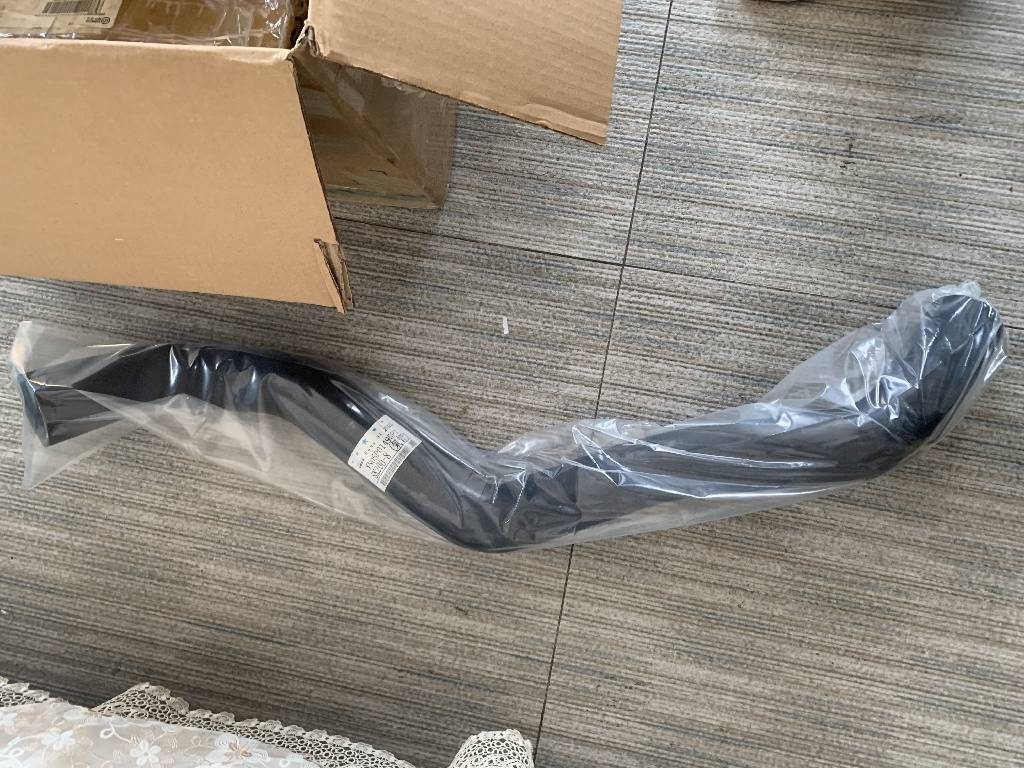
A Kobelco that smokes black under load and pulls like it has lost a cylinder is usually assumed to have a fuelling or turbo problem. On the J05-powered machines, a leaking charge-air circuit produces exactly the same symptoms for a fraction of the cost, and it is the first thing worth ruling out. Guangzhou Shenyue Machinery Technology Co., Ltd. supplies both the hose and the cooler, so this guide follows the order that avoids selling a turbocharger to a machine that needs a clamp.
What a charge-air leak feels like
The intercooler sits between the turbocharger and the inlet manifold. It cools compressed air so more oxygen enters the cylinder; when pressure escapes on the way, the engine receives less air than the fuel map expects. The result is a rich mixture: black smoke under acceleration, sluggish response, higher exhaust temperature and, on later machines, a derate or a boost-deviation code. Idle is often normal, which is what convinces owners that the engine itself is healthy.
The joints fail before the core
Hoses, clamps and O-ring joints take the vibration and the heat cycling, and they fail first. On the SK210-8 the intercooler-to-engine air hose is recorded under YN05P01495P1, and that hose is the usual suspect on a machine with oil-damp dust around the joint: a small leak weeps oil mist, the mist catches dirt, and the dirty ring points at the failure. The cooler itself is recorded under YN05P01439P1C and LQ05P01309P2C, and the pipes on the larger machines under LC05P01526P1 for the SK330-8 and SK350-8. The SK350-10 uses LC05P01849P1, with a red-coated variant recorded as LC05P01846P1.
How to prove it in twenty minutes
Work from the outside in. With the engine off, run a hand along every charge-air joint and look for that damp dust ring; squeeze the hoses for soft spots and check that the clamps sit square, not cocked. Start the engine and listen at the joints for a hiss that follows throttle. Then load the machine and watch boost against the specification for the engine — a charge-air leak shows low boost with high exhaust temperature, while a tired turbo usually shows low boost with oil in the pipework. A soap solution on the joints while a helper holds revs will find the rest, and a pressure test of the core confirms a cracked tank before you remove it.
| Symptom | Most likely cause | Confirm by |
|---|---|---|
| Black smoke only under load | Charge-air leak at a joint | Damp dust ring, soap test |
| Whistle that rises with boost | Split hose or loose clamp | Visual and squeeze test |
| Oil in the pipework, blue smoke | Turbo seal wear | Shaft play check |
| Coolant loss, white smoke | EGR cooler, not charge air | Coolant pressure test |
Why black smoke is not automatically the turbo
A restricted air filter produces the same rich mixture, so check the intake first — our air filter guide covers the restriction test. An exhaust manifold leak produces a soot streak rather than a boost loss, and an EGR cooler failure shows coolant loss and white smoke, which is the subject of the D04EG EGR cooler guide. Only after these are excluded does the turbocharger become the prime suspect, and even then the housing and wheel should be inspected before replacement.
Before you order: note the model, serial and engine plate, then photograph the failed joint in place. Guangzhou Shenyue Machinery Technology Co., Ltd. checks the hose number against the plate because the same engine family uses different pipes across models and generations.
What actually fixes it
Most charge-air repairs are a hose, a set of clamps and an hour of labour, and the replacement is quoted as genuine or aftermarket so the choice is explicit. Replace clamps in sets rather than one at a time, clean the joint faces, and check that the new hose is not twisted when tightened. If the core is cracked, pressure-test the replacement before fitting, and blow through the pipework to clear any debris that entered during removal. Garrett's technical library at garrettmotion.com explains how boost pressure and air density interact, which helps when a customer wants to know why a small leak changes performance so much. Replacement hoses and cooler assemblies for these machines are listed under engine parts, and Guangzhou Shenyue Machinery Technology Co., Ltd. can quote them through the contact page in one message.
Frequently Asked Questions
Does a charge-air leak cause black smoke on a Kobelco?
Yes. Escaping boost pressure leaves the engine short of air, so the fuel map runs rich and the exhaust turns black under load. Guangzhou Shenyue Machinery Technology Co., Ltd. recommends checking charge-air joints before authorising a turbocharger replacement.
Which hose fails most often on an SK210-8?
The intercooler-to-engine air hose recorded under YN05P01495P1 is the usual failure, together with its clamps. Look for a ring of oil-damp dust around the joint as the first sign.
How do I tell an intercooler leak from a failed turbo?
A charge-air leak gives low boost with high exhaust temperature and no oil in the pipework, while turbo seal wear usually leaves oil in the pipes and measurable shaft play. A soap test and a boost gauge settle the question in minutes.
Is the intercooler the same on SK330-8 and SK350-10?
No. The SK330-8 and SK350-8 use pipe LC05P01526P1, while the SK350-10 uses LC05P01849P1 or the red-coated LC05P01846P1. Always quote the plate details so Guangzhou Shenyue Machinery Technology Co., Ltd. can match the correct pipe.