Steel tracks are the right answer on rock, mud and demolition, and the wrong answer on a finished surface. Paving contractors, landscapers and anyone splitting time between site and street know the pattern: an hour on asphalt and the shoes have chewed the surface, the operator is deaf from the noise, and the machine has thrown gravel from every joint. Rubber pads bolt or clip onto the steel shoes and solve exactly this problem. Guangzhou Shenyue Machinery Technology Co., Ltd. supplies undercarriage parts and quotes pad sets against measured shoes, and this guide explains when pads pay off, which type fits and how to order a set that actually fits your machine. Shoe widths themselves are covered in our guide to track shoe width and grouser selection.
What pads change, and what they cost
A pad set turns a steel-tracked machine into something a city job site will accept: no surface damage, far less noise, less vibration into the operator and fewer complaints from the people who own the pavement. The trade-offs are real. Pads wear faster than steel on abrasive ground, they tear off on sharp rock and rebar, and trapped debris between pad and shoe accelerates the very undercarriage wear they were meant to excuse. Pads also add a little height to the track, which changes clearance slightly, and noise reduction alone is often the deciding factor for night work and residential sites. On rock, demolition and continuous rough ground, plain steel remains the correct choice; pads belong on mixed work where the machine must be polite on finished surfaces.
Bolt-on or clip-on
Two fitting systems dominate. Bolt-on pads fix through bosses in the shoe with a dedicated bolt, which makes them the secure choice for machines that see real hours: they cannot walk off the shoe edge, and a single pad can be replaced without disturbing the row. Clip-on pads clamp over the shoe edges and are fitted without drilling, which makes them the fast choice for machines that move between pad-friendly and pad-hostile sites, and for rental fleets that fit pads only when the site demands it. The honest comparison is security versus reversibility, and the shoe itself decides: not every shoe profile carries bosses for bolt-on fitting, so measure before choosing.
| Application | Best choice | Why |
|---|---|---|
| Paving and roadworks | Bolt-on pads | Full hours on hard surfaces |
| Site and street mixed | Clip-on pads | Fitted and removed as needed |
| Rock or demolition | No pads | Pads tear off and add cost |
| Rental fleet | Clip-on pads | One machine, many sites |
How to order the right set
Pad sets are ordered against the shoe, so the measurements matter more than the model name. Measure the shoe width across the rail, confirm the shoe pattern and count the shoes per side, and note whether the shoe carries bosses for bolt-on pads. Rubber pads are commonly quoted items that do not sit in a standard on-line catalogue: the manual for the serial and the shoe itself are the authority, and a set ordered off a model name alone is the most common mistake we see. Guangzhou Shenyue Machinery Technology Co., Ltd. quotes against those measurements and marks every item genuine, OEM or aftermarket at quotation.
Fitting and looking after the set
Fit pads with the track clean and dry, seat every fixing to the torque figure in the manual, and re-torque after the first hours of work as the manual directs, because pad bolts relax as the rubber beds in. After fitting, clear packed mud and ice from between pad and shoe whenever the machine is parked, since trapped material works the pads loose and chews the shoe edges. A pad set on a healthy, correctly tensioned undercarriage is a routine consumable; the same set over a neglected undercarriage is a short experiment. Buyers who run mixed brands can cross-check pad and undercarriage references across brands on corbayparts.com, our international export site, and Kobelco's own undercarriage documentation sits at kobelco.co.jp. Send measurements and enquiries through the contact page and we will quote the set against the serial.
Frequently Asked Questions
Can rubber pads be fitted to any Kobelco steel track?
Mostly, but the shoe decides the system. Bolt-on pads need shoes with bosses, while clip-on pads clamp over the shoe edges and fit without drilling. Guangzhou Shenyue Machinery Technology Co., Ltd. quotes against the measured shoe width and pattern, not the model name alone.
How long does a set of rubber pads last?
It depends almost entirely on the ground. On clean pavement a set works for a long service life; on rock, rebar and demolition the pads tear off early. Pads are a consumable for polite surfaces, and the manual for the serial gives the inspection figures.
Do rubber pads damage the undercarriage?
Not by themselves, but trapped debris between pad and shoe accelerates shoe and edge wear. Clean the gap at rest periods and keep the track tensioned to the manual's figure, and the pad set behaves as a normal consumable.
Which undercarriage parts should be checked before fitting pads?
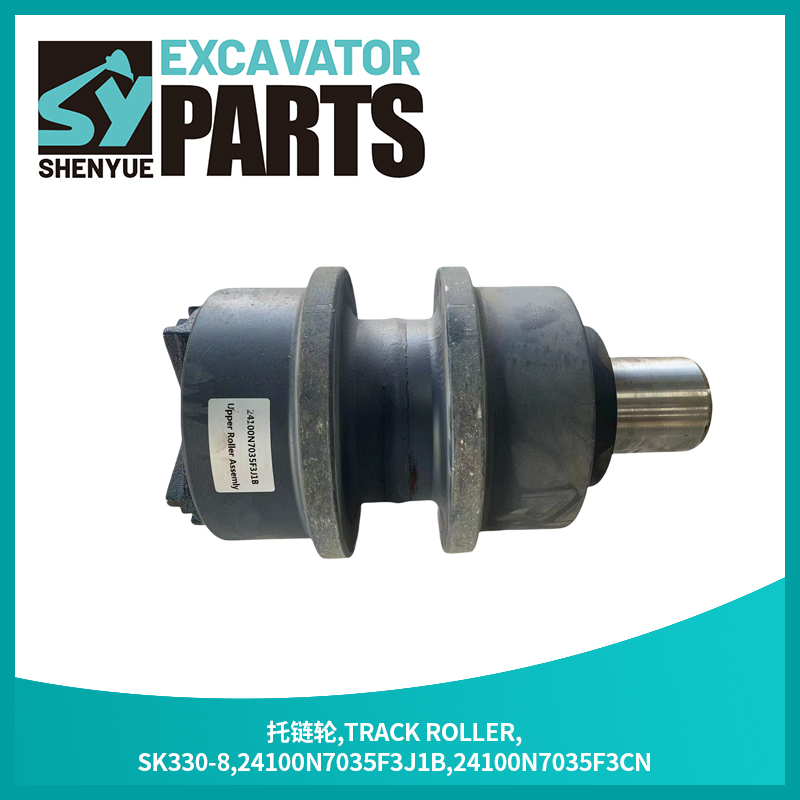
Roller and idler flanges, shoe condition and track tension. Our stock list carries items such as the SK330-8 track roller 24100N7035F3J1B and the idler shaft VA32F2303402, and Guangzhou Shenyue Machinery Technology Co., Ltd. confirms every reference against the machine serial.