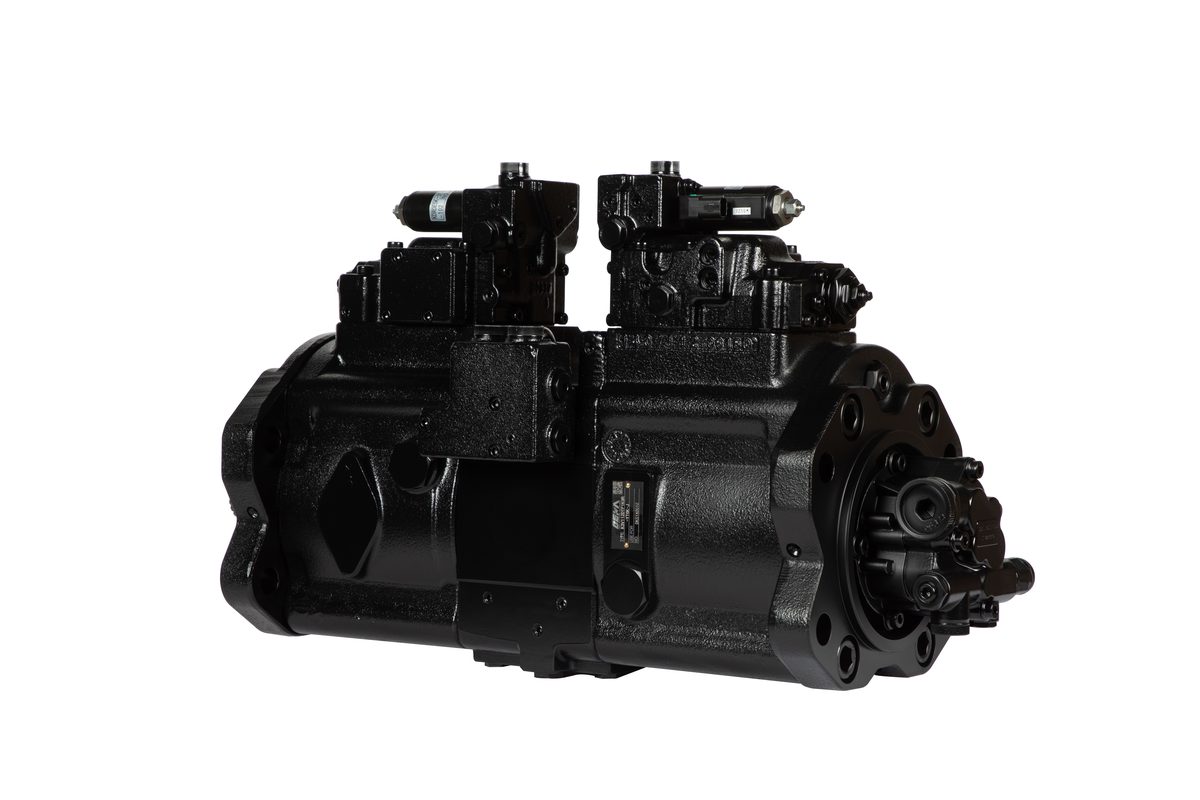
Few workshop stories are more expensive than this one: the machine was slow, the pump was blamed, a complete replacement went in — and the machine is just as slow as before. On a Kobelco SK200-8 with its K3V112DT, or a SK330-8-class machine with a K5V140, the pump is only one of five systems that can produce the same symptom. Guangzhou Shenyue Machinery Technology Co., Ltd. supplies the pump families and everything around them, and this is the check order we suggest before and after a pump change.
First: was the pump actually the fault?
The honest starting point. A pump loses output through internal wear, and that shows up as slow speed under full load while pressures test near specification. If the machine was slow because the regulator was not driving the pump to stroke, or because the suction side was starving it, the worn pump was a passenger, not the driver. Before condemning any pump, the pressure and flow picture must exist — the tap locations and the readings to take are set out in our test port guide.
Second: the regulator that steers the pump
The regulator is the small component that decides how the pump strokes against load, and it fails far more often than the pump body. A regulator stuck in a low-output position produces exactly the same complaint as a worn pump: full relief pressure, slow everything. Our records quote the K3V112DT regulator family under 29070821-4927 and YN10V01006F2, and the diagnosis — including how to read the regulator against the pump — is walked through in our regulator guide. If the old pump was replaced without testing the regulator, test it now, because the new pump inherits the old problem.
Third: the suction side that starves it
A pump cannot pump what the tank will not feed. A clogged suction strainer, a collapsing suction hose or a tank breather choking produces cavitation noise on a cold morning and chronic slowness thereafter. Our records quote the suction strainer family under YN15V00077F1, and the tank-side layout, the strainer position and the cleaning routine are covered in our suction strainer guide. Cavitation damage also shortens a new pump's life, so clearing the suction side protects the replacement as much as it fixes the symptom.
Fourth: the pilot supply behind the commands
Every operator command is hydraulically translated through the pilot circuit, and a weak pilot supply makes the whole machine feel worn: slow response, soft cycles, low breakout. A loaded pilot filter or a tired pilot pump produces it. Our records quote the pilot filter under YN50V00020F1, and the pilot-side checks — pressure, filter and the hand pilot valves — are set out in our pilot test guide.
Fifth: the valve and the actuators
Only after the pump, regulator, suction and pilot sides are cleared does the control valve become the suspect: a stuck spool, a failed line relief or an internal leakage path bleeds flow before it reaches the actuator. At that stage the circuit diagram reading method and the per-circuit pressure checks separate valve faults from actuator faults. Kawasaki's pump and valve background for machines of this class is described at khi.co.jp.
Why the relief valve confuses the picture
The main relief valve is the machine's pressure ceiling, and a relief set low or stuck slightly open caps the whole machine below its rated force — which reads as "slow" to the operator. The confusion is that relief pressure tests can look healthy at idle while the valve leaks under the flow and heat of real work. A cold machine that tests fine and warms up slow is a classic pattern here. Our records quote the main relief family under V9510318049-T, and the safety circuit's role in the pressure picture is set out in our relief valve and safety circuit guide. Test the relief setting at working temperature before ordering anything in this tier.
Getting the parts for the real fault
Guangzhou Shenyue Machinery Technology Co., Ltd. keeps the complete cast — pump assemblies including the K3V112DTP-YT0K for SK200-8, SK210-8 and SK250-8 and the K5V140 class, regulators, strainers, pilot filters and relief valves such as V9510318049-T — as part of more than 3,000 part types on the shelf, with over 100,000 part numbers available to order, graded genuine, OEM or aftermarket. If your diagnosis has crossed brands or classes, our colleagues at excavatorpartsglobal.com quote the same components for the wider machine park.
Frequently Asked Questions
Can a new pump be slow from day one because of another part?
Yes. The regulator, the suction side and the pilot circuit can each produce the same slow-machine symptom as a worn pump, and a new pump inherits all of them. Test at the ports, then regulator, then suction, then pilot before touching the valve.
Which part steers pump output on a SK200-8?
The regulator on the K3V112DT, recorded under 29070821-4927 and YN10V01006F2 in our records. It fails more often than the pump body, and a regulator stuck at low stroke gives full relief pressure with slow cycles — exactly the symptom blamed on the pump.
What does a clogged suction strainer do to a Kobelco excavator?
It starves the pump, producing cavitation noise and chronic slowness, and it shortens a new pump's life through cavitation damage. Our records quote the strainer family under YN15V00077F1; clean or replace it and check the suction hose before condemning a pump.
Does Guangzhou Shenyue Machinery Technology Co., Ltd. supply complete pump assemblies?
Yes — including the K3V112DTP-YT0K for SK200-8, SK210-8 and SK250-8 and the K5V140 class for the SK330-8 tier, as part of more than 3,000 part types on the shelf and over 100,000 part numbers available to order, each graded genuine, OEM or aftermarket.