Travel brake problems hide behind three different complaints: a machine that creeps on a slope after the levers come back to neutral, a travel start that feels slow and hesitant, and a final drive housing that runs hot on one side. All three can be described as "brake trouble", but they have different causes, and the expensive mistake is opening a final drive that was never at fault. Guangzhou Shenyue Machinery Technology Co., Ltd. supplies travel motor parts for the SK range and asks workshops to work this order before ordering anything.
Where the brake actually lives
On Kobelco machines the wet parking brake is built into the travel motor, ahead of the reduction gears. Oil pressure releases the brake when travel is commanded; springs apply it when pressure falls. The brake valve portion sits with the motor's control section, and the brake plates, pistons and seals are inside the motor case. That layout matters for diagnosis: the symptom may be electrical, hydraulic or mechanical, and the final drive gears are usually innocent.
Generations matter too. The SK200-8 and SK210-8 carry the GM38VB; the next generation moved to GM38VC, and the two do not interchange. Internal parts cross inside a family, never across the boundary.
The check order, from cheapest to most invasive
| Step | What to check | What it tells you |
|---|---|---|
| 1 | Behaviour on level ground vs a slope | Creep only on a slope points to apply-side wear; drag on both points to pressure |
| 2 | Case drain flow at the travel motor | Excess internal leakage lowers release pressure — the brake never fully releases |
| 3 | Brake release pressure when travel is commanded | Low release pressure means pilot supply or seal trouble, not worn plates |
| 4 | Housing temperature on both sides | One hot side isolates the fault to that motor |
| 5 | Brake plates, piston and seals on the bench | The confirmation step, only after the pressure checks |
Pressure figures for brake release and case drain limits are not figures we quote from memory — they are commonly quoted per model and must be read from the service manual for the machine in front of you. What we can say from parts records is where the failures sit: seals and plates first, then the piston bore, and rarely the housing itself.
What the parts records show
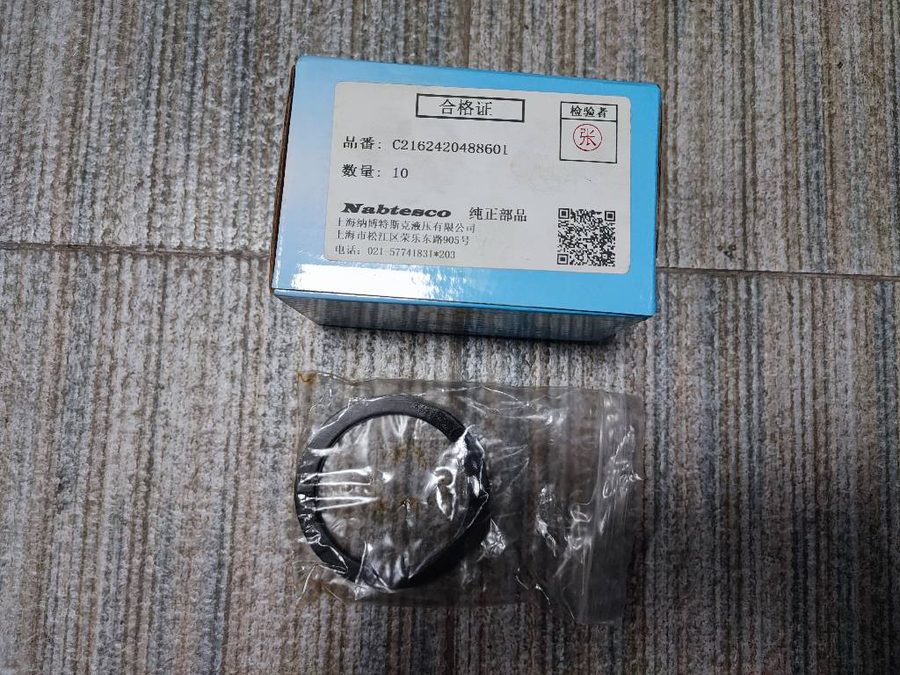
Our records carry the GM38VB assembly under C800D2016-00 with YN15V00037S116 as the related number, the GM85VA as LS15V00020F1, and GM35VA internals for the smaller class. Inside a motor, the wear items we replace most often are the ball guide C2162420488601 with LC15V00023S042, the cylinder block C2162221251701 with LC15V00023S040, the swash plate C2162122059801, and the travel motor relief C2259321450501 with LC22V00006F1. A dragging brake and a slow motor often share the same root: internal leakage that steals the pressure the brake needs to release.
Do not confuse the parking brake with the towing release
A towed Kobelco needs its brakes manually released, and that procedure has its own dedicated article. The release bolt is an emergency tool, not a maintenance setting; leaving it open to "cure" a dragging brake simply parks the symptom and lets the machine roll when the ground is not level. If a machine needs the release more than once, the brake system has a fault — work the order above.
Seals decide whether the repair lasts
Brake drag that returns within a season is almost always a seal story: new plates behind a hardened or worn seal set release unevenly and drag again as the oil heats. The seal material guidance published by NOK explains how much seal life depends on oil condition and temperature. The GM38VB guide covers the -8 motor internals, the slow travel and one-track guide covers the wider travel diagnosis, and our hydraulic components range lists what we keep on the shelf. For anything beyond the filters and seals layer, send the motor number and photos to Guangzhou Shenyue Machinery Technology Co., Ltd. through the contact page before ordering.
Frequently Asked Questions
Why does my Kobelco creep on a slope but not on flat ground?
Because the brake plates are the worn element: on flat ground nothing tests them, but on a slope the springs must hold the machine and a worn plate set lets it creep. Guangzhou Shenyue Machinery Technology Co., Ltd. recommends checking case drain flow and release pressure before ordering plates.
Can a dragging brake damage the travel motor?
Yes. Continuous drag turns the brake into a heat source inside the motor case, cooking the oil and hardening the seals next to it. A drag that returns after a plate replacement usually means the seals were not replaced with the plates.
Are GM38VB and GM38VC travel motors interchangeable?
No. GM38VB covers the SK200-8 and SK210-8; GM38VC arrived with the next generation and changed the mounting and control interface. Internal parts cross inside each family only — our records carry the GM38VB under C800D2016-00 with YN15V00037S116 related.
Is it safe to keep towing a machine with the brake release open?
Only for the tow itself. The manual release is an emergency measure covered in our towing guide, not a fix. If a machine needs repeated releases, the brake system has a fault that should be diagnosed by the pressure check order before more parts are bought.